Beginners Course March 2026

Featured

Book NowIf you are total beginner the next CARISMA beginners course will start on Tuesday 17 March2026 at 5:45pm to run for 4 consecutive Tuesday and Thursday classes (e.g. 17, 19, 24 and 26 March).

We would like to gather numbers to be prepared so it would be great if you could leave, confidentially, your name in this form. Also please make sure to turn up before 5:45pm at Kelsey Kerridge as there might be a long queue.

Please refrain from joining if you are leaving Cambridge immediately after the beginners course ends. It makes sense for you to join the beginners course just if you are available to attend it until its end, with the intention of joining our club after the beginners course ends and train with us for the months to come. According to our philosophy martial arts take time to be learnt to a minimum level of proficiency.
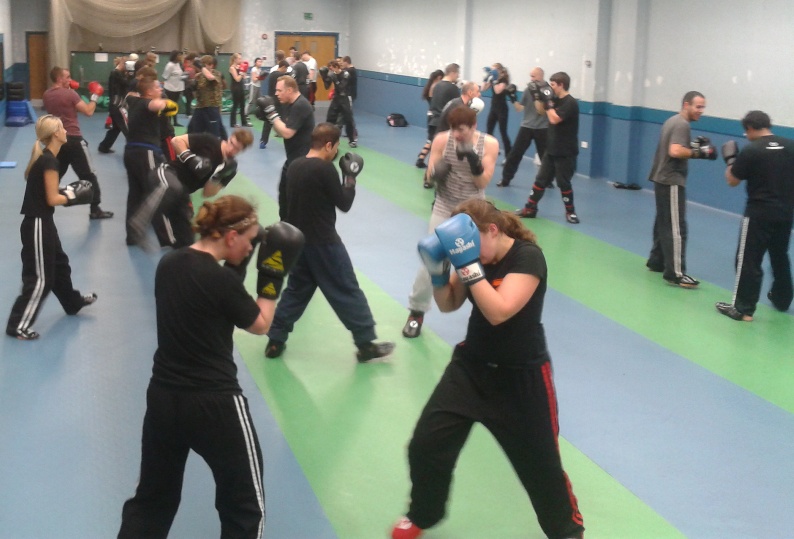
busyclass

If you have previous and relevant experience in martial arts please read the join page and join us at any time, e.g. no need to wait for the beginners course. Please get in touch with us if in doubt. If you’d like to check our prices please look at this page. Please notice that Kelsey Kerridge charges a day entry to every non member entering their premises.

Our kind of members: the layered journey from white to black belt at CARISMA

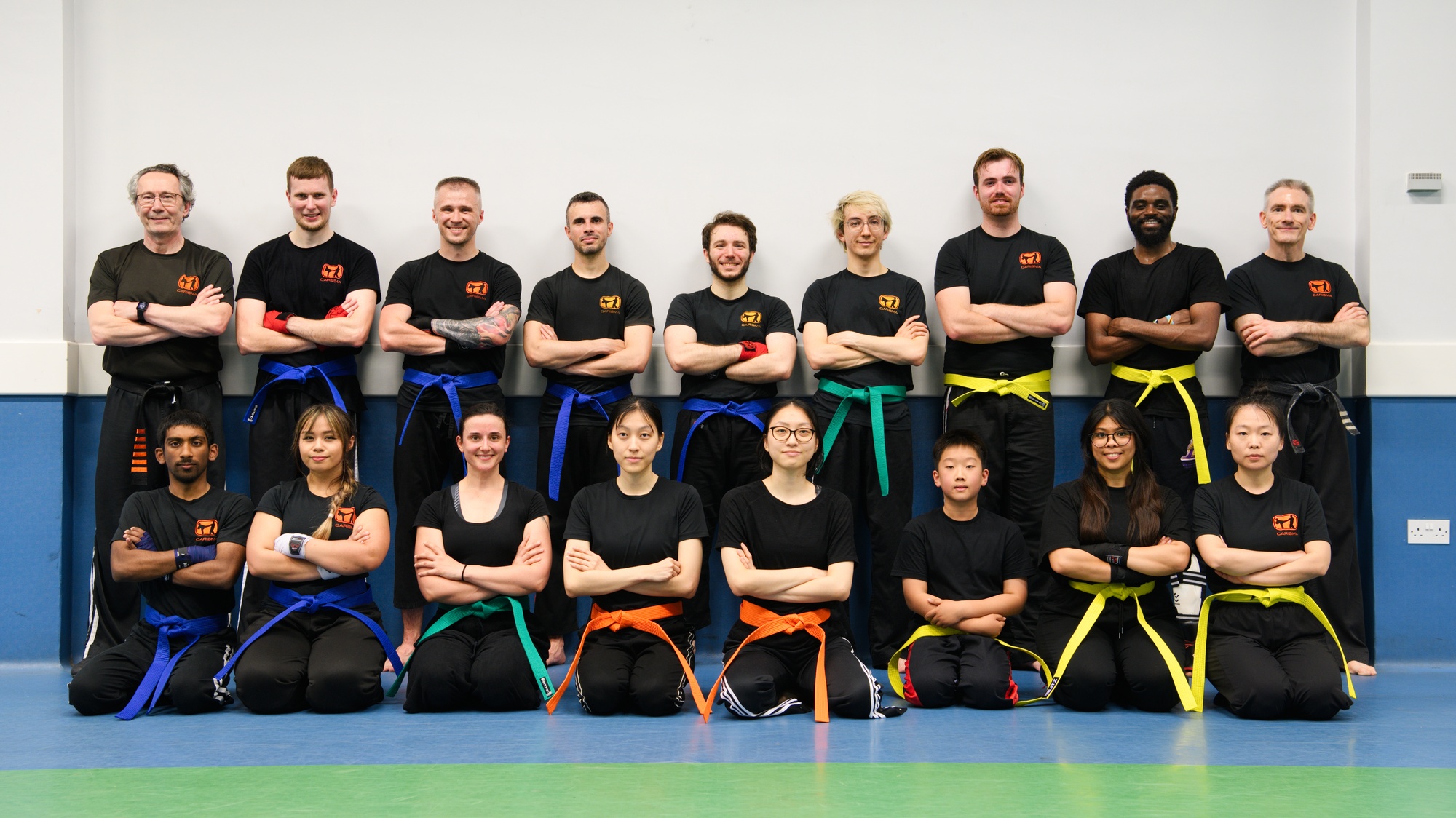
At CARISMA, we don’t just teach kickboxing; we live it. Our passion, at least the one of the keen members and instructors, lies in the grit, the technique, and the personal evolution that comes from stepping into our training hall. We are an open door for anyone—regardless of where they start—who is ready to explore their potential and reap the physical and mental rewards of martial arts. However, we don’t just “collect” members. We nurture martial artists. We view our community through five distinct layers of progression, reflecting a member’s rank, commitment, and the sharpening of their character.

Layer 1: the foundation (White, Yellow, and Orange)

Every journey begins with the first step, in this case, with the courage to be a beginner. In this initial stage, we look for consistency:

  • Expectation: training 2–3 times out of our 4 weekly classes.
  • Focus: building the habit. This is where you learn the language of kickboxing and start conditioning your body for what’s to come.

As people are training consistently the instructors start noticing some people sticking out from the crowd; they attend regularly, they quickly become known faces. Some of them turn up early and trying to practice and apply techniques which are not working for them, until they do.

Layer 2: the transformation (Orange Second, Green and Green Second Belts)

For those who are committed enough to last for about 1 year of steady sweat, the “newbie” shell starts to crack. We expect to see a visible shift in their physical capabilities:

  • Physicality: fitness, strength, endurance and flexibility starts to be noticeably higher.
  • Technicality: punches are crisper, kicks are faster, guard is constantly protecting and movements are more intentional. Even on a gentle sparring they are no longer as easy to hit with basic punches and kicks.
  • Dedication: this is where we see an “increased dedication”—the realization that martial arts isn’t just a hobby, but a discipline and more of a weekly habit.

Here we notice a small number of members who become keener and keener; they get involved in sparring and try their first fight, usually light contact.

Layer 3: the ascent (Blue and Brown Belts)

This is the “extra mile” phase. By the time they reach Blue Belt, the Black Belt is no longer a distant dream—it’s a visible point on the horizon:

  • Blue Belt: we notice members pushing beyond the standard curriculum. Coordination becomes second nature, and sparring moves from “surviving” to “competing competently.”
  • Brown Belt: this is the penultimate step. At this stage, we want members who are hungry for the graduation. They aren’t just practicing; they are preparing to represent the club at the highest student level.

Some exceptional individuals, can be selected to become assistant instructors and offered to get involved in helping out.

Layer 4: the new beginning (Black Belt)

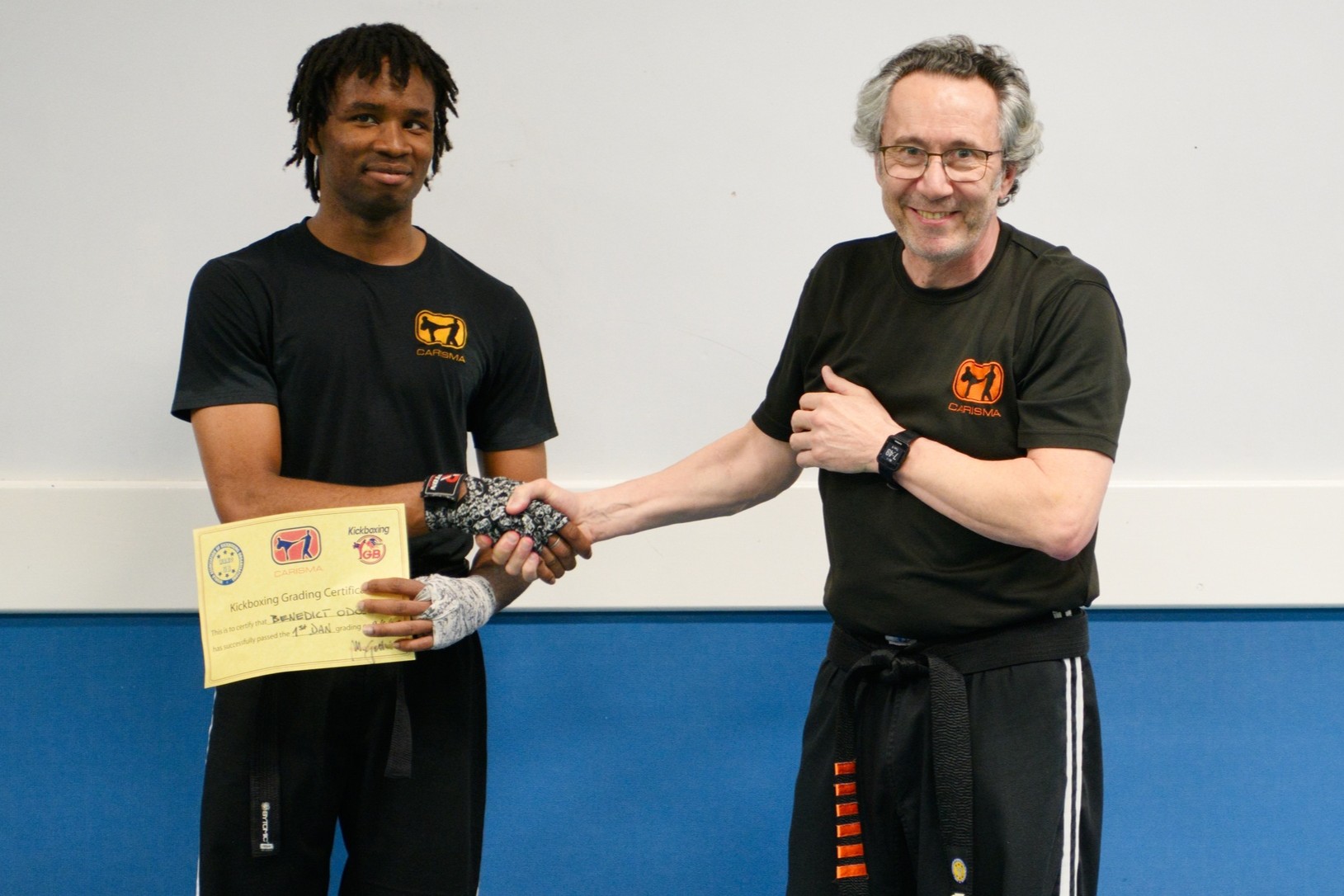
For many, the Black Belt is seen as the finish line. At CARISMA, we see it as the new starting point. “From White to Black Belt takes roughly four years of intense, dedicated training. But once that belt is tied, the real journey begins.” This is where the dedicated martial artist truly begins to shine. The technique is ingrained, the fitness is peak, and the mind is disciplined. You’ve graduated from learning the craft to mastering the art.

Layer 5: instructors and coaches

Many of the members who became black belt at CARISMA over the years had a position as instructors.  Some instructors achieved this position without yet wearing a black belt. At CARISMA we select very carefully who are those dedicated and technically sound members who have the knowledge and personality to run classes. We expect a very high level of dedication and consistency to training and fitness to ensure all instructors can show and do every technique we practice as well as being able to teach and coach any member around techniques, blocks, guard, footwork and sparring methodologies.

The CARISMA timeline

While everyone moves at their own pace, here is a general look at the commitment required:

Milestone Timeframe Primary Focus
White to Orange Months 1–12 Consistency & Core Basics
Green Belts Year 1–2 Fitness, Speed & Strength
Blue to Brown Year 2–4 Sparring, Coordination & Dedication
Black Belt 4+ Years Mastery & Advanced Practice

Whether you are here to get fit or to eventually wear the Black Belt, we are ready to help you push your limits. The question is: are you ready to find your layer?

From resilience and discipline to inner power: how martial arts shape the next generations

A few weeks ago, I received a call that reminded me exactly why we do what we do at CARISMA. It was from a father in Cambridge whose 10-year-old son had recently been bullied and, unfortunately, physically assaulted, however slightly. The father, having practiced martial arts in his own youth, knew the transformative power of the dojo. After researching several clubs in the area, he reached out to me because of the philosophy he saw reflected on our website. He wasn’t just looking for someone to teach his son how to throw a punch or a kick; he was looking for a place where his son could rebuild his world and pave the way for self confidence.

The post-pandemic shift

While we haven’t historically been a “children’s club,” the last few years have seen a fascinating shift. Since the end of the COVID-19 pandemic, we have seen a flourishing of 12-to-15-year-olds—both boys and girls—joining our classes. Watching these young people evolve is one of the most rewarding aspects of coaching. In a world that felt very small and uncertain for a long time, these teens are finding their space. We see them grow:

  • Physically: developing the coordination, strength, and “explosive power” of a true martial artist.
  • Emotionally: moving from the hesitancy of early adolescence to a grounded, calm sense of self.

The pillar of confidence, discipline, and respect

At CARISMA, we don’t sugarcoat the training. We train hard, however within the limits and aspirations of each individual. But it is through that “hard” work that the most beautiful transformations happen. Young people today are often over-stimulated but under-challenged. When they step into our gym, they learn discipline and resilience—the ability to do what is required even when they are tired. They learn respect—for their partners, their instructors, and, most importantly, themselves. “Training hard helps these young people build a core of confidence that no bully can shake.”

The Paradox of Self-Defence

People often ask if we teach “self-defence.” My answer is often a bit different than what they expect. True self-defence isn’t just a set of techniques; it is a state of mind. It is mostly learnt by being so confident in your ability to fight that you no longer feel the need to prove anything to anyone. However, if you ever need to protect yourself bit hitting someone your strike will be powerful, efficient and hitting where it does the most damage. The best thing is that when a young person knows they can defend themselves, the “need” to demonstrate it vanishes. They carry themselves differently. Their shoulders are back, their eyes are up, and that internal security acts as a far more effective shield than any physical move ever could. They aren’t looking for a fight; they are simply no longer afraid of one.

Building the future

It is a privilege to watch these teenagers develop into powerful martial artists and, more importantly, resilient young adults. Whether it’s a 10-year-old regaining his footing or a 15-year-old finding her strength, we are here to provide the tools for that journey.


How we prepare athletes for full contact fights

Let’s be real: stepping into a ring for three rounds of two minutes sounds like a short commitment until someone is actively trying to take your head off. Full contact fighting isn’t just a sport; it’s a high-stakes puzzle solved under extreme physical and mental duress. We don’t start from zero. We assume our athletes are already “keen” kickboxers with a solid foundation. Our job is to take that raw skill and forge it into a weapon that can withstand the extreme pressure of a real fight. Here is how we bridge the gap between “decent” and “proficiently safe”.

The first step, a few words of caution

My conversation with any aspiring full contact fighter is to ensure they understand these basic concepts:

  • This is not going to be a walk in the park or even a marathon run where there is one winner and many participants. It will be you and your opponent in the ring and one of the two will be a winner
  • You are entering a sports competition where your opponent is trained and authorised to hurt you, within the regulations which are enforced by a referee
  • Our aim is to train you to win but, if you don’t make it, you will lose in a way that it will minimise your damages

Refining the arsenal: efficiency over flash

In a full-contact environment, every movement must have a purpose. We strip away the “fluff” and focus on the mechanics of single techniques. If a jab isn’t snapping or a round kick isn’t turning the hip over correctly, it’s wasted energy.

  • Maximum damage: we tweak body mechanics to ensure every strike carries the weight of the entire body, not just the limb
  • The “iron shield” guard: offense is great, but if your chin is in the air, the fight ends early. We drill “active defence,” ensuring that even while attacking, the opposite hand is glued to the jaw and the shoulders are tucked

The science of the combination

Throwing a single punch is easy. Throwing a four-strike combination that leaves you protected and ready to counter is an art form. We train our fighters to deliver sequences that flow naturally and exploit the opponent’s defensive reactions. We consider these different aspects of the action:

  • Flow: Eliminating the “reset” pause between a punch and a kick during a combination to improve speed of any combination
  • Angle cutting: moving off the centreline during the combination and keeping a tight guard at all times to avoid counter attacks
  • Damage density: ensuring that every punch or kick in a combination delivers damage the final (exit) strike is the most powerful

Power, meet volume

It’s one thing to hit a heavy bag hard once. It’s another to maintain that “knockout power” in the final thirty seconds of the third round when your lungs are screaming.

We push our athletes through high intensity interval drills that mimic the rhythm of a fight: explosive bursts followed by active recovery. The goal is simple: be able to hit harder than ever before and keep doing it for as long as the referee allows.

The mental fortress: concentration under fire

The biggest challenge in full contact isn’t the pain—it’s the panic. When fatigue sets in, the first thing to go is the mind. You lose your “eyes,” you stop seeing the openings, and you forget your guard. We use pressure testing to build mental resilience. By the time our fighters step into the ring, they have already been in deep water during training. They’ve learned to keep their focus sharp and their breathing steady, even when the pressure is beyond what most people expect.

The payoff: why we do it

Training for full contact is, frankly, exhausting and occasionally painful. But it pays dividends that few other experiences can match.

  1. Minimized damage: proper preparation is the best insurance policy against injury
  2. Unshakeable assurance: knowing you have the “gas in the tank” and the skills to handle a hostile opponent provides a level of self-confidence that carries over into every aspect of life
  3. The satisfaction of the grind: there is a unique pride in knowing you didn’t take the easy road.

Reach your peak of performance: why American kickboxing is the ultimate modern martial art

In a world filled with countless fitness trends and combat styles, American kickboxing stands out as a “Goldilocks” discipline: it perfectly balances the refined technique of traditional martial arts with the raw intensity of modern fighting sports.  At CARISMA, we have seen firsthand how this sport serves as a powerful catalyst for personal growth, whether you are a child finding your feet or an adult looking to reclaim your edge. Here is why American kickboxing is a sport everyone should experience.

A Masterclass in Physical Versatility

Most sports specialize in one area—distance running for stamina, weightlifting for strength, or yoga for flexibility. American kickboxing demands all of them.

  • Agility & Reflexes: The fast-paced nature of the sport sharpens your “fight-or-flight” response, turning it into calculated “read-and-react” precision.
  • Total Body Strength: From the rotational power of a cross punch to the explosive drive of a roundhouse kick, every muscle group is engaged.
  • Dynamic Flexibility: High kicks aren’t just about looking spectacular; they require and develop incredible range of motion in the hips and core, which protects the body against injury in everyday life.

Building “The Resilience Muscle”

Life is unpredictable, and American Kickboxing is the perfect training ground for handling pressure. In the gym, you learn to keep your guard up when you’re tired and stay focused when things get difficult. This translates directly into mental resilience. For adults, it is the ultimate stress-reliever—a place where the frustrations of the workday are channelled into the punching bag or a fully padded training partner who can help you with training. You don’t just leave the gym fitter; you leave it calmer and more capable of handling life’s challenges.

From Children to Confident Adults

For younger practitioners, we accept children from 12 years of age, the benefits go far beyond the physical. The American kickboxing we teach at CARISMA provides a structured, disciplined environment where children learn the value of discipline, respect and hard work while having fun.

  • Self-Confidence: There is a unique kind of confidence that comes from knowing you can defend yourself. This isn’t about aggression; it’s about the quiet “inner warrior” that allows a child to stand tall against bullying and peer pressure.
  • Development: It turns “fidgety” energy into focused coordination, teaching children how to set goals and work toward them through grading and technique mastery.

The Spectacular “Art” in Martial Arts

There is no denying it: American kickboxing is spectacular to watch and even more exhilarating to practice. The “blitzing” movements, the combination of Western boxing hands and Eastern martial arts kicks, and the fluid movement across the mats make it one of the most dynamic sports in existence. It is never boring. Every session is a new puzzle to solve, a new combination to master, and a new level of fitness to unlock. While many clubs limit their practice to a few combinations which use 2-3 punches and a couple of kicks at CARISMA we practice the full spectrum of punches and kicks plus combinations which include multiple kicks with one leg.

A Safe, Inclusive Community

At CARISMA, we believe that while the sport is rooted in combat, the environment should be supportive. We specialize in making the art accessible to everyone—from college and university students and busy professionals to local residents of every gender. Our focus on controlled training ensures that you can push your limits and build amazing skills without the high risk of injury found in less-structured environments. We encourage everyone to push themselves beyond their comfort zone, without risking to be overwhelmed or putting their safety at risk. Anyone interested in competing and prepared to put the hours in will be given access to opportunities of fighting in both light and full contact bouts.

Why Starting Now?

Whether you are looking for a way to get into the best shape of your life, seeking a discipline that builds character in your children, or simply wanting to learn a practical and effective self-defence system in Cambridge, American kickboxing is the answer. It is a sport that gives back exactly what you put in: strength, agility, and a level of self-confidence that will stay with you long after you’ve stepped off the mats.